When Pain Challenges Belief
Recently, in conversation with a brilliant and ardent lifelong atheist friend, the question of suffering arose. It is a question that frequently emerges in mental health work, particularly with individuals who have endured severe trauma, loss, or injustice. If there is a creator, why would such suffering be allowed at all?
My friend argued that believing in a caring creator in the presence of moral atrocities requires an overinflated sense of self-importance, perhaps even a degree of delusion. How, he asked, could a being who cares permit such pain?
I responded that it may require an even greater overinflated sense of self-importance to assume we are equipped to fully understand the ethics, intentions, or purposes of a creator. To believe that a finite human mind can accurately evaluate the moral framework of a higher intelligence may itself reflect a significant overestimation of our cognitive reach.
We do not always know why events unfold as they do. Human cognition is not designed to answer every existential question or to perceive the full scope of causality. This is where faith becomes relevant, not as denial or avoidance, but as an acceptance of cognitive and perceptual limits.
To illustrate this idea, I turn to a familiar children’s story, Pinocchio.
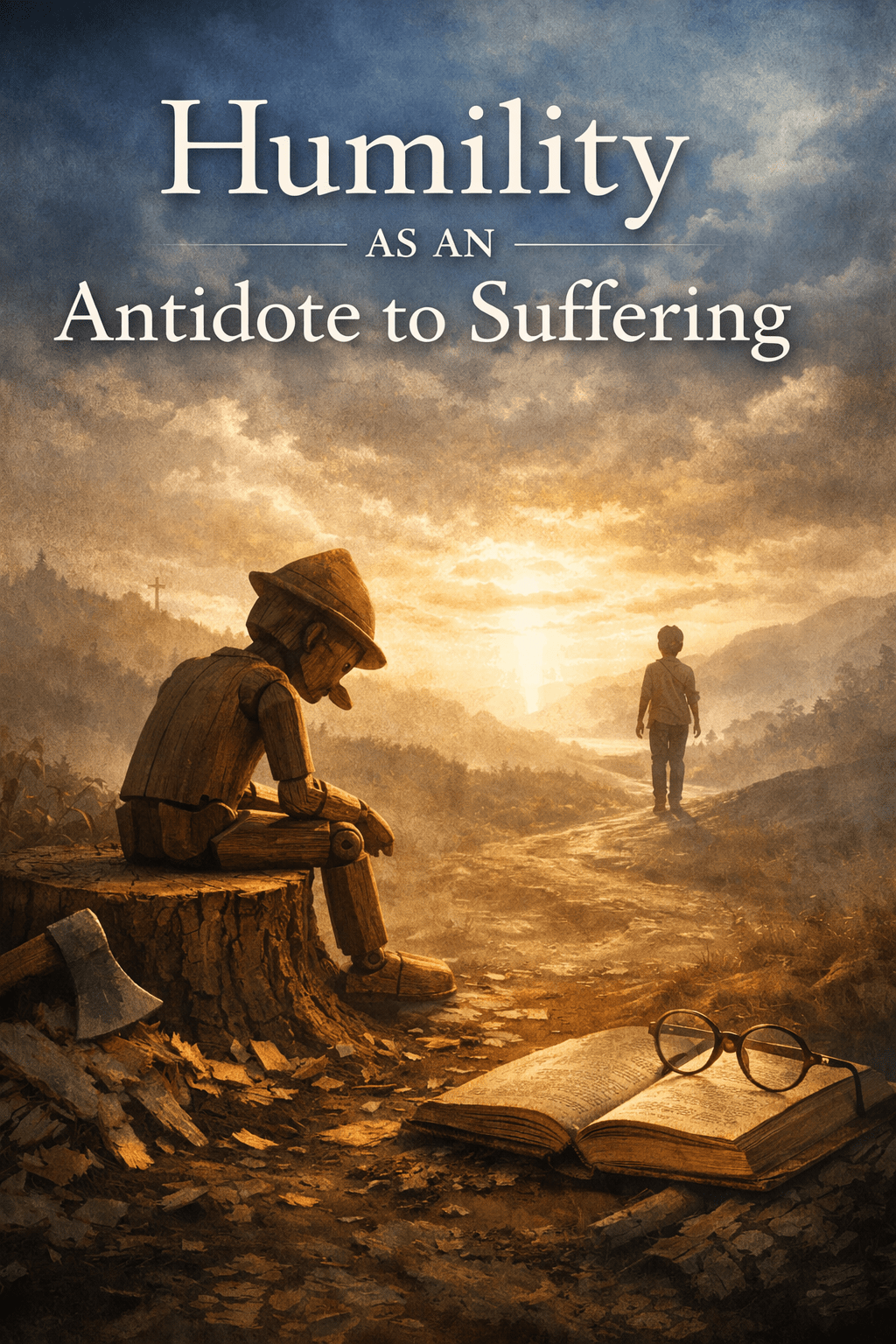
The Pinocchio Analogy
It seems cruel to the tree when it is cut down. It seems futile and exhausting as it is whittled away. It may appear meaningless when it is shaped and painted into a doll. It may seem trivial when the doll is told not to lie. Yet when the doll learns to trust the guidance of his creator and follow the rules laid before him, he becomes a real boy. Only then does he understand that the tree’s sacrifice was necessary, and that finite minds cannot always grasp the purposes of the infinite.
Conclusion
Suffering is not proof of indifference. Like the tree that cannot yet see the boy it will become, individuals often experience pain without access to its broader context or purpose. From within the process, the loss feels destructive and the constraints feel arbitrary. Faith, in this sense, is not a rejection of suffering, but an acknowledgment of human limitation and a willingness to accept that meaning may exist beyond immediate understanding.
 Manton (Max) Bailie